


Running a full-service agency means juggling projects across design, development, and marketing. Each discipline has its own challenges, but clients expect them to work together seamlessly and deliver fast results.
As you grow, cracks appear. One client needs a campaign launched yesterday, another wants a custom integration, and a third expects flawless performance during a traffic surge. Meanwhile, your team is bouncing between staging sites, updates, and fixes that quietly drain valuable time.
The truth is, what slows agencies down isn’t creativity or strategy, but the infrastructure underneath. The right hosting partner turns that invisible layer into an advantage, helping you scale with confidence, keep projects moving, and deliver consistent results clients can measure.
In this article, we’ll look at the biggest challenges full-service agencies face and how the right hosting partner can make growth feel a lot more natural.
The challenge of scaling a full-service agency
Dealing with a single client project is manageable, as you can dedicate time to details, chase down approvals, and troubleshoot issues as they arise. Scaling that same model across dozens or even hundreds of clients is where the cracks start to show.
Full-service agencies feel this acutely because you’re not delivering just one kind of service. You’re expected to handle web development, performance optimization, creative campaigns, and ongoing marketing support, often for clients with very different expectations and tech stacks.
That diversity is a valuable asset, but it also multiplies the operational load. Developers spin up WordPress installs and chase plugin conflicts, marketers wait on fixes before launching campaigns, and account managers are stuck keeping clients reassured when performance dips or timelines slip.
Here’s how it plays out in practice:
- Fragmented hosting setups: One client is on a reliable platform, another is still on low-cost shared hosting, and another insists on sticking with an outdated stack. Your team is forced to learn three different workflows just to keep things afloat.
- Campaign chaos: A retail client’s Black Friday sale kicks off, and their site crashes under the surge of traffic. Developers scramble to apply performance fixes in real time, marketers pause campaigns mid-flight, and sales slip away by the minute.
- Staging slowdowns: Your design team ships a batch of new landing pages, but staging sites are buggy or painfully slow. QA drags on for days, campaign testing can’t begin, and launch timelines slide. Clients may experience delays, but internally, your team knows it’s the infrastructure that’s causing the issue.
- Client expectations vs. team bandwidth: One client wants daily reports, another urgent checkout fixes, and another SEO updates. Without centralized tools, account managers waste hours chasing the basics.
Multiply those issues across dozens of accounts, and a straightforward workflow becomes a constant fire drill. The bigger you grow, the sharper the trade-off: either add more people or accept that your team spends as much time troubleshooting as creating. Neither is sustainable.
Scaling requires rethinking the support behind the work. Without reliable infrastructure, skilled teams are asked to carry weight they shouldn’t, and that slows growth more than any missed campaign ever could.
That’s why the next challenge agencies face isn’t just about people or processes but about the WordPress infrastructure on which everything runs.
Why WordPress infrastructure becomes critical at scale
It’s easy to focus on design, campaigns, and messaging as these are what clients see, but the real test of an agency’s ability to deliver at scale is the infrastructure underneath.
Once you’re managing multiple high-demand accounts, that invisible layer becomes the difference between smooth launches and constant firefighting.
For agencies, infrastructure quality isn’t a box to tick. It comes down to five factors that directly shape results:
- Uptime: Clients don’t care why a site went down; they only see lost sales and missed opportunities. Even a few minutes offline during a launch can mean thousands lost.
- Performance: Slow pages kill conversions, tank ad quality scores, and drag down SEO. A two-second lag on checkout can double cart abandonment.
- Security: A single breach doesn’t just hit one client; it damages trust in your agency as a whole.
- Scalability: Campaigns live or die by traffic spikes. Infrastructure that buckles under load forces your team into crisis mode instead of optimization.
- Workflow efficiency: It’s not just about speed and uptime. Developers, marketers, and account managers need staging, role-based access, and real-time analytics to keep projects moving.
When infrastructure falls short, the ripple effects are costly. Developers patch instead of building, marketers delay campaigns, and account managers manage frustration instead of growth. From the outside, it looks like a “technical hiccup,” but inside, it’s lost hours, missed revenue, and weakened trust.
At scale, those inefficiencies define your ceiling. Weak infrastructure limits how many clients you can serve and how confidently you can take on complex projects. A strong WordPress infrastructure does the opposite, creating a foundation for smooth collaboration, reliable results, and growth that feels effortless.
Collaboration without bottlenecks: Tools for multi-client workflows
Managing multiple clients means shifting gears constantly by launching an e-commerce store one moment, tweaking SaaS landing pages the next, all while maintaining long-term retainers. That context switching creates friction when each project lives in a different environment.
Kinsta removes that friction with tools built for multi-client workflows.
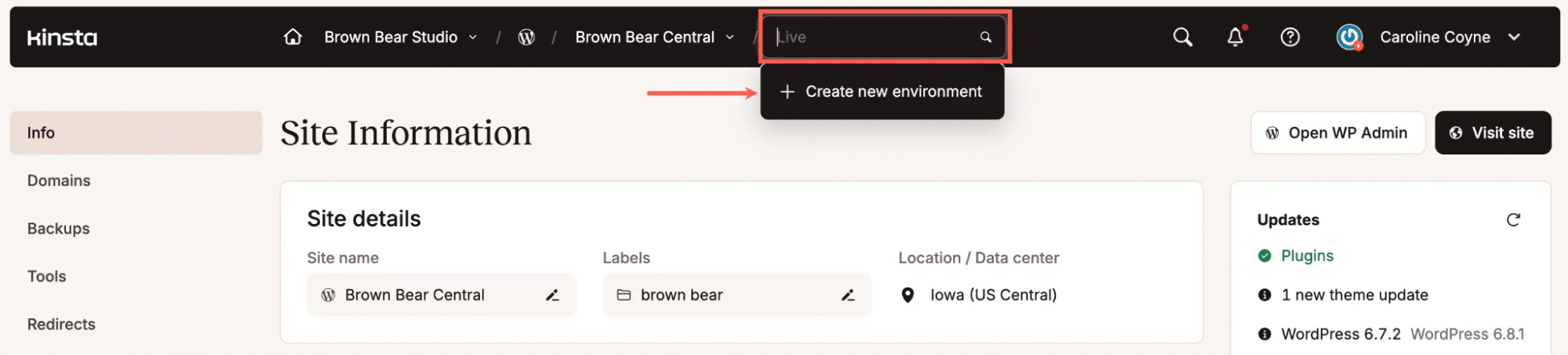
For example, you can view all your projects in a single dashboard. Domains, databases, backups, and usage stats are visible at a glance, with role-based permissions so developers, marketers, and clients see exactly what they need. That means fewer errors, faster handoffs, and smoother onboarding.
One-click staging also lets teams test without risk. Developers can safely trial updates and integrations, marketers can preview real campaign environments, and clients can review working sites instead of static screenshots. Approvals come faster, launches go smoother, and downtime isn’t a worry.
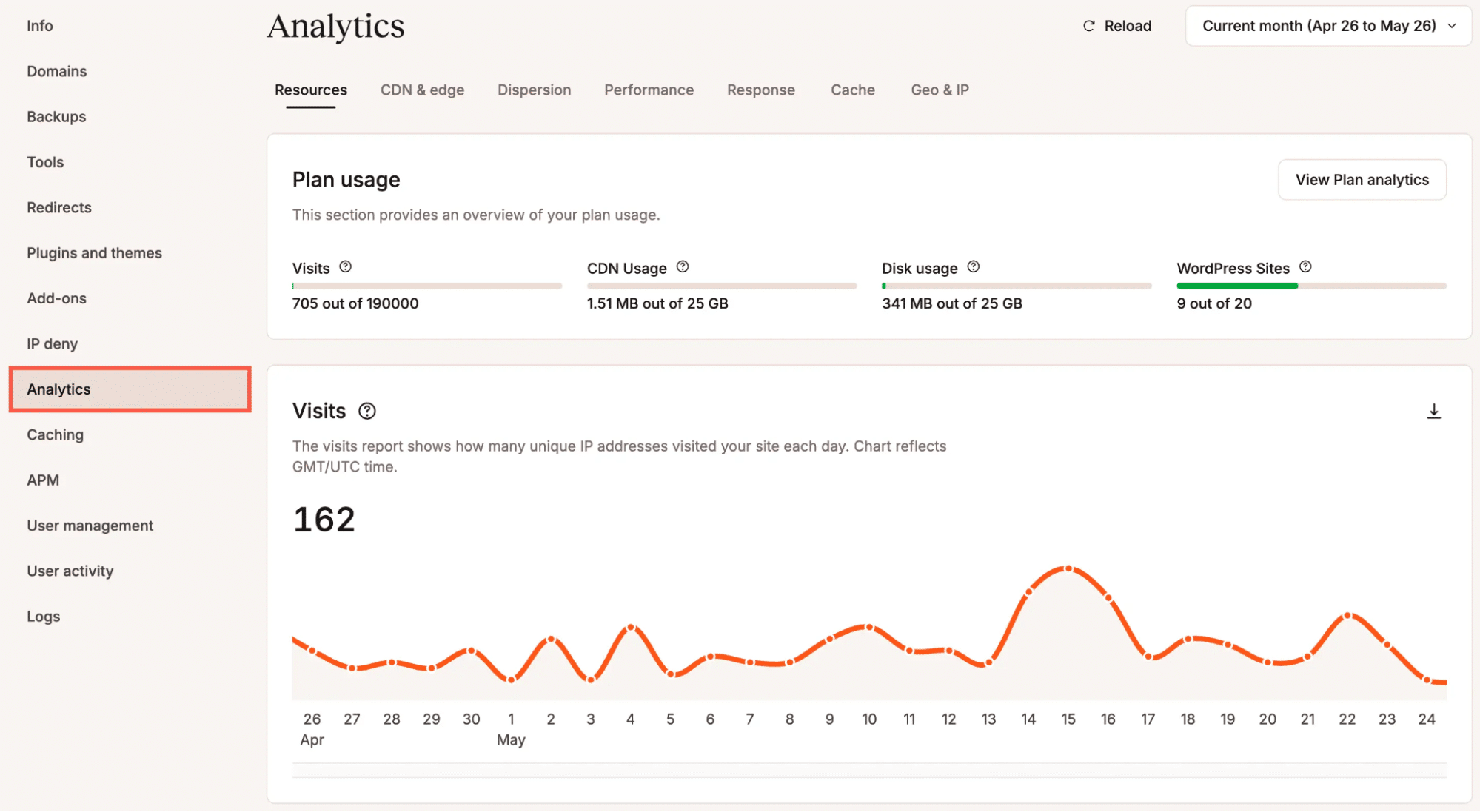
Real-time analytics in MyKinsta give account managers proof. They can tie site speed, uptime, and Core Web Vitals directly to campaign performance, walking into client meetings with hard numbers instead of vague reassurances.
Together, these tools turn collaboration from a juggling act into a streamlined process. Developers keep building, marketers keep launching, and account managers keep clients confident, all on the same solid foundation.
Kinsta: The right hosting partner for your agency
At the end of the day, agencies aren’t judged on how smooth their internal workflows feel. They’re judged (rightfully) on the results clients see.
That’s why choosing the right hosting partner isn’t just about keeping sites online. It’s about creating the conditions for your team to deliver faster, with fewer roadblocks, and with performance that clients can measure.
Kinsta’s platform is built with that in mind.
- Deliver faster results: Kinsta’s speed-focused infrastructure, including built-in CDN and edge caching, gives your clients a competitive advantage. Faster sites improve the user experience, lift conversion rates, boost ad quality scores, and enhance SEO rankings.
- Reduce overhead: With staging tools, analytics, and automated backups built into MyKinsta, your team spends less time troubleshooting and more time focusing on billable work that grows the business.
- Improve retention: Clients stick around when they see consistent uptime, stable performance, and proactive support. Hosting is invisible when it works, but your clients will notice when their campaigns run smoothly and their sites perform under pressure.
The best part? Your agency gets the credit. Clients see reliable, high-performing sites, but behind the scenes, you’ve got enterprise-grade infrastructure doing the heavy lifting. Kinsta becomes the silent partner that lets your agency focus on strategy, design, and marketing while still delivering results that feel effortless to your clients.
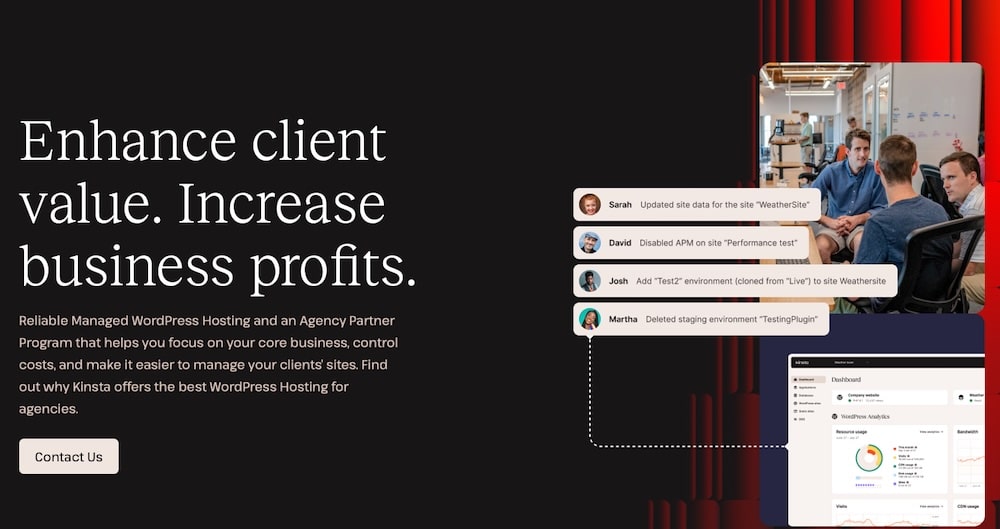
If you want to explore that partnership, you can learn more through the Kinsta WordPress hosting for agencies or explore WordPress hosting features built specifically for agencies.
Summary
Scaling a full-service agency isn’t just about hiring more people or landing bigger accounts. It’s about building a foundation that supports every piece of the work your teams do, design, development, marketing, and client management.
When infrastructure gets in the way, you feel it everywhere: campaigns delayed, billable hours lost, and clients questioning results.
The agencies that break through those limits are the ones that treat hosting as a partner, not an afterthought. With Kinsta, you get infrastructure that delivers speed, stability, and scalability out of the box, plus the tools that make collaboration easier across every team. That translates into faster launches, more reliable campaigns, and lasting client relationships.
If you want to give your agency that edge, talk to our sales team to explore and learn more about how our infrastructure can fuel your growth.

Kinsta
Senior Editor at Kinsta, WordPress Web Developer, and Content Writer. Outside of all things WordPress, I enjoy the beach, golf, and movies. I also have tall people problems.


