


“Enterprise-ready.”
It’s a term that’s used a lot in the website hosting space, but it’s often misunderstood.
For many providers, the label seems to mean “we can handle a lot of traffic.” However, being able to handle high-traffic websites doesn’t automatically make something enterprise-ready.
Instead, enterprise environments are defined by governance, operational controls, security processes, and risk management.
While WordPress as a platform is enterprise-ready, the way some hosting companies serve up the world’s most popular CMS can cause confusion and doubt about whether WordPress can meet the needs of enterprise organizations.
In this article, we unpack what “enterprise-ready” should actually mean when hosting WordPress sites.
We cover why many hosts misuse the term, the real details needed for enterprise hosting of WordPress, and how Kinsta has built an enterprise hosting platform based on controls and functionality rather than marketing terms.
How many WordPress hosts misuse the term “enterprise-ready”
If you look at the enterprise hosting plans from many WordPress hosts, you see a trend:
Often, the only differentiator between “regular” and “enterprise” hosting plans is the amount of website traffic each plan can handle.
While traffic scalability is important to many enterprises, focusing exclusively on traffic lets hosts avoid addressing whether they can truly offer what enterprises need.
Any competent cloud platform can scale to handle traffic, so meeting traffic demands alone is not the differentiator between regular and enterprise hosting. Instead, the ability to handle high-traffic websites is only one part of the puzzle.
In the next sections, we cover why it doesn’t make sense to conflate “enterprise website hosting” with “high-traffic website hosting,” as well as the enterprise controls that are often missing on many WordPress hosts.
High traffic does not equal high risk
A fundamental issue with how many hosts approach being “enterprise-ready” is assuming that a “high-traffic website” is the same as a “high-risk website.”
While many enterprises do need support for high traffic, it’s essential to differentiate between “high-traffic websites” and “high-risk websites.”
For example, consider two websites:
- Website 1: A blog posts funny pictures of cats and receives 10 million visitors per month.
- Website 2: A website for an enterprise B2B business with high-value products receives 10,000 highly qualified visitors per month.
Even though the first website receives significantly more monthly traffic, the second website poses a greater risk and has distinct organizational needs.
High-risk websites typically have some or all of the following factors:
- Brand reputation is on the line: Any downtime or security problems can cause serious reputational damage and negatively impact other business metrics.
- Compliance requirements: Enterprises typically have unique compliance requirements, regardless of how much traffic they receive.
- Internal governance policies: In addition to external compliance, large organizations often have their own internal policies that they need to follow.
- Multiple stakeholders: Enterprises typically need to give multiple stakeholders access to hosting environments, oftentimes with different levels of access.
- Security audits and vendor reviews: Enterprise organizations need a host that can pass security audits and vendor reviews. Often, this requires the host meeting certain requirements, such as ISO and SOC 2 certifications.
Put simply: all enterprise websites are high-risk websites, but not all enterprise websites are high-traffic websites.
The missing controls in many “enterprise” WordPress hosts
By overly focusing on high-traffic sites being the deciding factor in enterprise hosting needs, many hosts miss the features and controls that enterprises need.
These missing factors can include the following:
- Weak environmental isolation
- Shared infrastructure risk
- Weak user permission controls
- Limited audit logging
- Inconsistent backup policies
- Limited operational guardrails
- Reactive rather than proactive security
- Missing internal guidelines and certifications, such as ISO and SOC 2 certifications
- Lack of vendor stability and maturity
In the next section, we discuss these requirements in more detail as we examine what makes a WordPress host “enterprise-ready.”
What really makes WordPress hosts “enterprise-ready”?
So far, we’ve focused on telling you what is not enterprise-capable hosting for WordPress. Now, we want to shift the focus beyond marketing terms and dig into what actually makes a WordPress host “enterprise-ready.”
A strong infrastructure foundation
One thing most WordPress hosts do get right is that enterprise websites need a strong and scalable infrastructure foundation.
Infrastructure needs to be:
- Completely isolated from other sites/accounts
- Stable and reliable
- Performant
- Scalable
Unfortunately, this is where a lot of WordPress hosts begin and end with enterprise hosting.
There’s a lot more to enterprise web hosting:
Governance & access control
Enterprise organizations also have unique needs when it comes to governance and access controls, which is something that a lot of hosts miss.
Some common functionality here includes the following:
- Environment separation: At a minimum, different environments for staging and production. Some enterprises also might need an additional development environment.
- Role-based access controls: This helps organizations control who has access to different sites and hosting areas. For example, organizations might want to give some users access to staging and development environments, but not to production environments.
- Single sign-on (SSO) support: Many enterprises prefer to use their own SSO provider rather than relying on separate hosting account credentials.
- Controlled deployment processes: Enterprises need to be able to control deployment processes and integrate them into their existing workflows.
- Audit-friendly workflows: Organizations also want to be able to audit who did what and when they did it, as these details are an essential part of internal governance.
Security as a system, not a feature
In enterprise hosting, security is not about offering a single feature. Instead, it’s about creating an entire system that works together to provide enterprise-level security.
Typically, this requires security at all levels:
- Application/environment: The host should protect the site and environment itself, with tools like firewalls, encryption, malware scanning, DDoS protection, etc.
- Account: The host needs to offer tools to control access and protect hosting accounts. This could include role-based restrictions, activity logging, two-factor authentication, and SSO provider support.
- Internal processes: The host also needs to have its own internal processes in place to build on those other security protections. The best application and account security won’t matter if the host has sloppy internal processes that expose websites to security risks.
Operational predictability and risk reduction
Enterprises also have a greater need for operational predictability and risk reduction in their hosting provider.
Some of the defining factors of operational predictability include:
- Defined service-level agreements (SLAs): Enterprises want to see SLA-backed guarantees for uptime and other key metrics.
- Transparent monitoring: Organizations need to know about outages or other issues, rather than having problems hidden away.
- Clearly defined incident response processes: Enterprise organizations need to know exactly how their hosting provider will respond in different situations.
Enterprise organizations also want to know that their hosting provider will reduce their infrastructure risk.
In addition to what we’ve already discussed, other aspects of vendor risk reduction can include:
- An established track record of stability as a hosting provider.
- Accountability when needed.
- Maturity as a vendor, with established infrastructure and policies
- Compliance with standards (like ISO-approved and SOC 2 certifications)
For many large organizations, ISO-defined certifications and SOC 2 standards are a non-negotiable part of the vendor review process.
How Kinsta can meet the true needs of enterprises
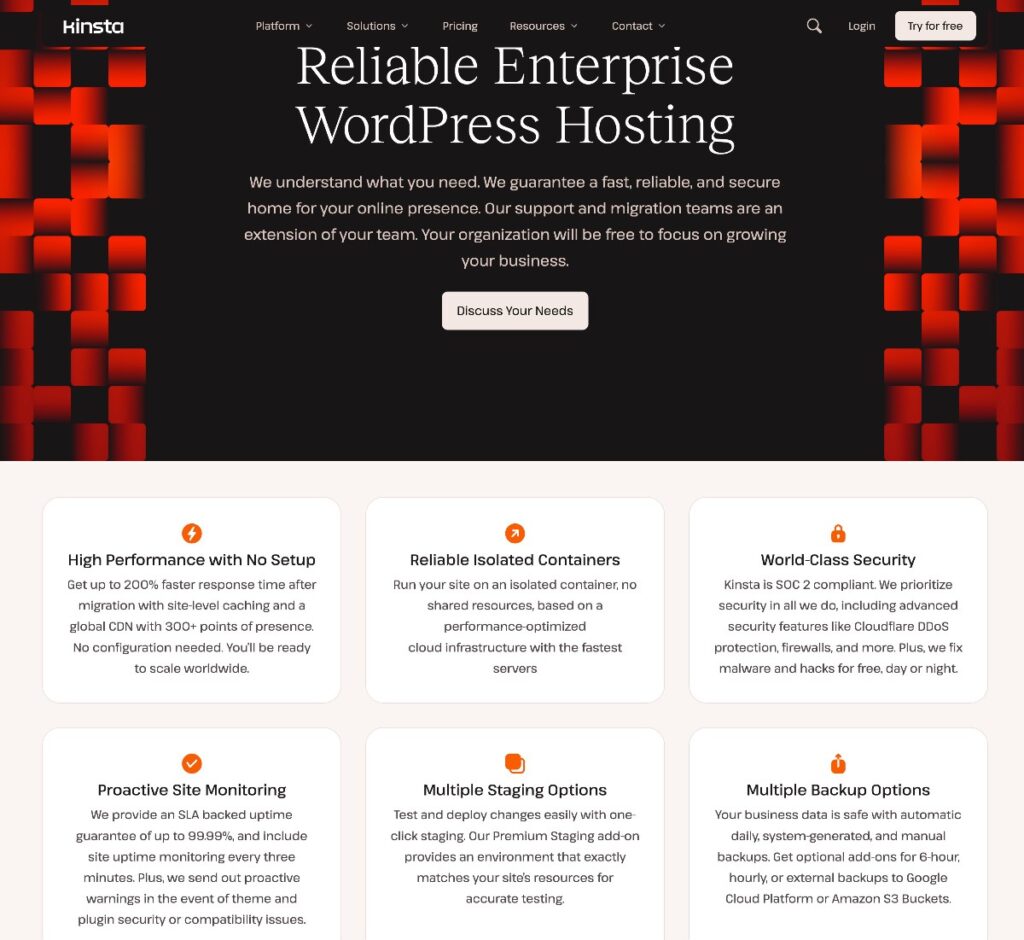
Kinsta’s enterprise hosting plans are not defined by marketing copy and slogans.
Instead of just focusing on support for high-traffic websites (which Kinsta can certainly handle), Kinsta has built a platform with the controls and functionality that enterprise organizations need.
Below, we look at how Kinsta goes beyond generic slogans to deliver truly enterprise-ready hosting…
Scalable infrastructure with isolation built in
To reliably host enterprise websites, Kinsta offers scalable infrastructure that fully isolates enterprise sites.
It starts with a reliable and low-latency global network for hosting. Enterprises can choose from dozens of data centers around the globe, and Kinsta’s containerized infrastructure keeps every site completely isolated, which is essential for enterprise reliability and compliance.
Kinsta’s dedicated hosting for WordPress plans also give enterprises the option to access even more control over their infrastructure and tailor RAM and CPU to their unique needs.
To further improve global availability and add redundancy, Kinsta’s platform also leverages Cloudflare’s global network on top of Kinsta’s cloud infrastructure. This adds global edge caching on the hundreds of locations in Cloudflare’s network, which speeds up load times and avoids a single point of failure.
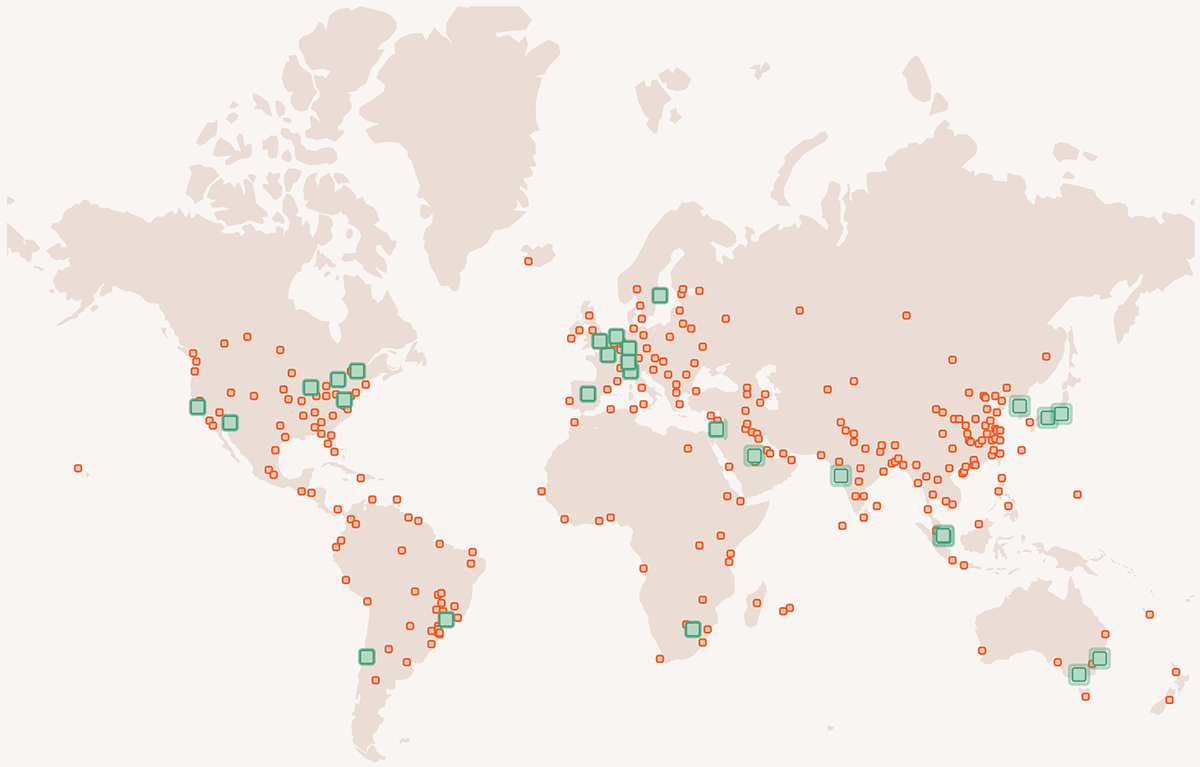
With this scalable approach to infrastructure, Kinsta can handle whatever your enterprise needs.
Predictable platform for deployments and uptime
Kinsta’s platform gives enterprise organizations a stable and predictable platform, with tools like controlled deployments, automatic backups, and built-in uptime monitoring.
Here are some of the features that can help enterprises reduce risk and achieve stability in their platform:
- Flexible staging environments: If needed, you can also add additional staging environments, with the option to add up to five separate staging environments for each WordPress site.
- Controlled deployments: You can use selective push to deploy from Kinsta’s staging environments, or utilize other tools such as DevKinsta for local development. Kinsta also supports Git and associated deployment workflows. For example, your organization can use platforms like GitHub, GitLab, or Bitbucket for continuous deployments.
- Backup automation: By default, Kinsta automatically creates a full daily backup of each site. Kinsta also offers add-ons to increase the frequency of automatic backups to hourly or every six hours and/or automatically store the backups on your own cloud storage provider (e.g. Amazon S3 or Google Cloud Storage).
- Built-in uptime monitoring: Kinsta includes built-in uptime monitoring to check your site’s status every three minutes. If there’s any website downtime, both you and Kinsta’s support engineers are automatically notified. This allows Kinsta’s support team to jump in and proactively fix issues when possible.
- SLA-backed uptime: Kinsta offers an uptime guarantee backed by its Service Level Agreement (SLA).
User account controls and governance
Kinsta also offers a number of tools to help enterprises control access, optimize team workflows, and implement internal governance policies.
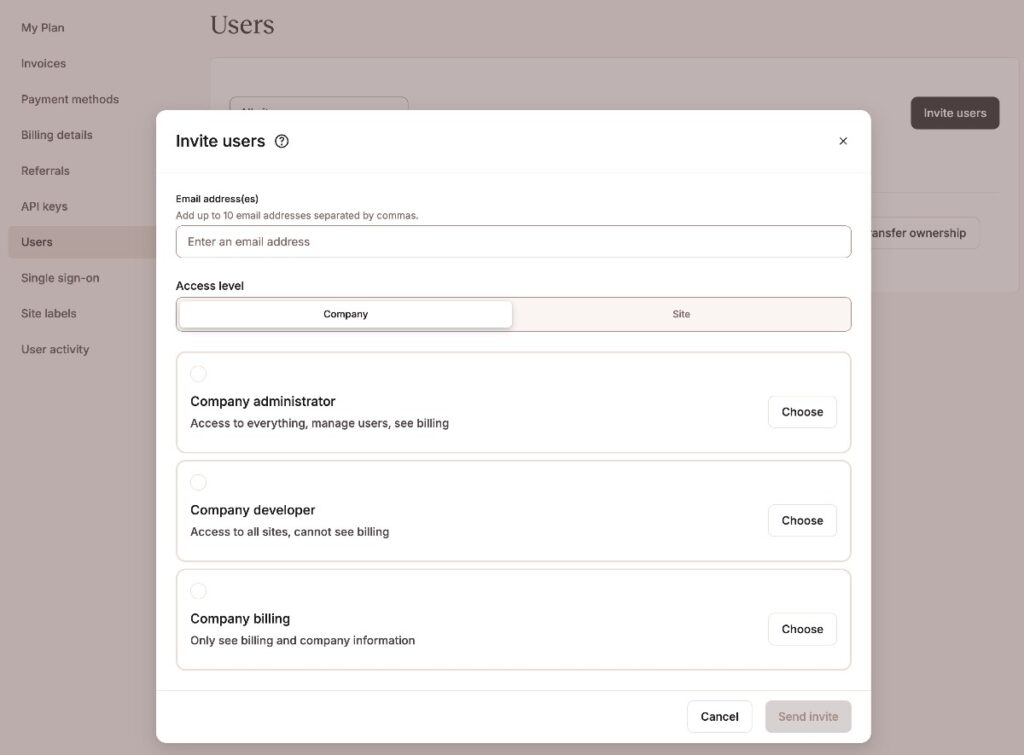
- Multi-user management: Enterprise organizations can add as many users as needed, which is great for larger teams and more complex workflows.
- Role-based access: You can easily control which sites and development environments team members have access to. For example, you could grant certain users access to a staging environment but not to the production environment. There are also non-developer roles, such as adding users who can only manage billing details.
- SAML single sign-on (SSO): Enterprises can connect their company-managed Identity Provider (IdP), such as Okta, OneLogin, Microsoft Entra, Google Workspace, and any other IdP that uses the SAML standard. You can choose whether to force all users to use the SSO or still allow users to log in with a username and password. There’s also an option to add manual exceptions to mandatory SSO.
- Two-factor authentication: Kinsta requires two-factor authentication for all users to access the MyKinsta dashboard, which boosts login security for organizations that aren’t using their own SSO provider. By default, Kinsta uses email-based two-factor authentication, but users can also set up authenticator apps.
- User and site activity logging: Kinsta tracks user and site activity in the MyKinsta dashboard, which can help enterprises with auditing and user-activity tracking.
Enterprise-level security
Kinsta offers out-of-the-box enterprise-level security, with a focus on proactive protection to prevent issues from occurring in the first place.
We’ve discussed some of these features before, but here’s a quick rundown of how Kinsta implements proactive enterprise security:
- Containerized environments with strict isolation.
- Encrypted storage by default and physical-layer network isolation.
- Free SSL certificates.
- A web application firewall at the network edge that applies the OWASP Core Ruleset (v3.3), powered by Cloudflare Enterprise.
- Smart DDoS (Distributed Denial of Service) protection.
- Continuous malware scanning.
- SSH Access with Key Authentication Only. Kinsta supports RSA, DSA, and ECDSA keys for secure workflows without compromising security.
- Internal controls and standards compliance. These include ISO and SOC 2 certifications.
In addition to infrastructure security, Kinsta also provides tools for organizational governance and security, as we discussed in a previous section. Here’s a quick recap:
- Multi-user access controls for the MyKinsta dashboard, including role-based access.
- Two-factor authentication for the myKinsta dashboard.
- Secure SSO using your own provider, including options to force SSO usage.
- User and site activity logging.
Internal controls and standards compliance
Kinsta’s internal controls and standards compliance are structured to support enterprise hosting for WordPress.
This includes certifications that are a must-have for many enterprise organizations, such as:
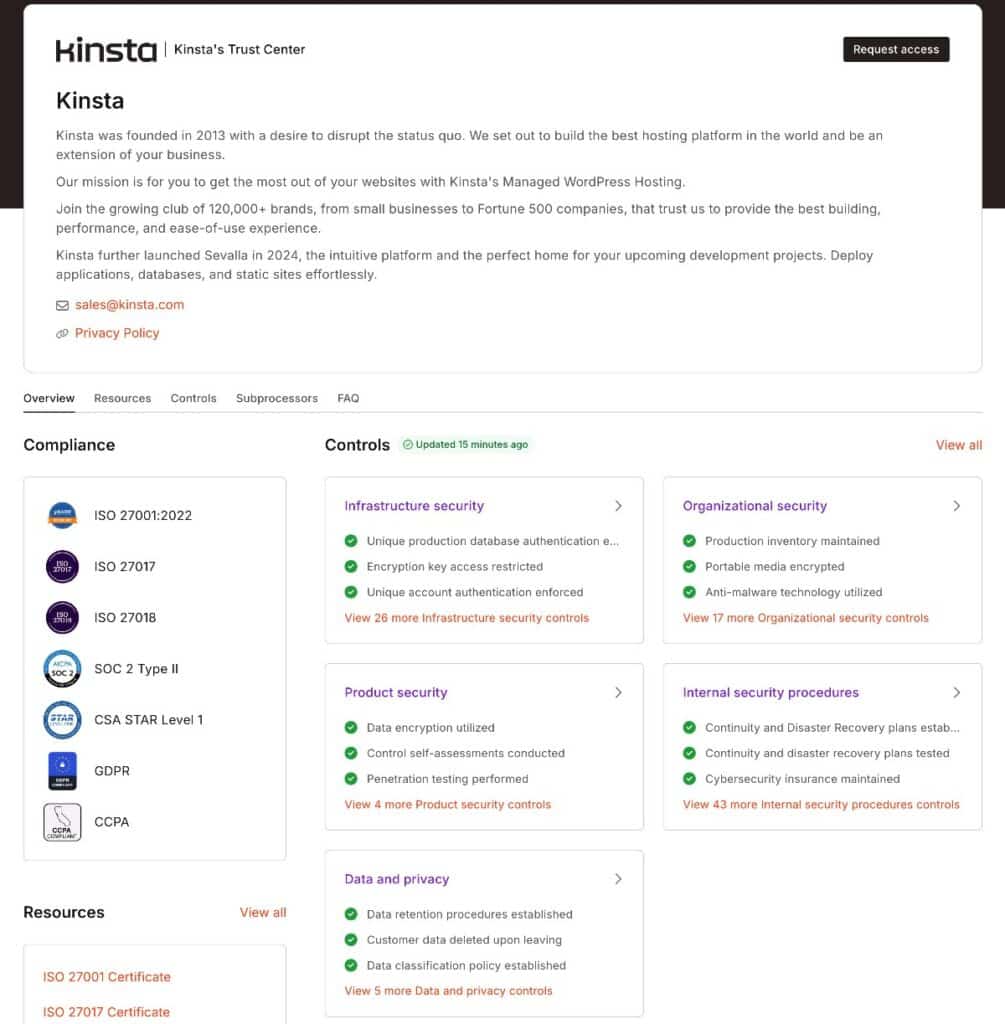
- SOC 2 Type II certification
- ISO 27001, ISO 27017, and ISO 27018 certificates
The Kinsta Trust Center, powered by Vanta, goes into detail on all of Kinsta’s controls and standards compliance, helping enterprise organizations more easily analyze Kinsta hosting, conduct vendor reviews, and make decisions.
Kinsta’s platform can also help enterprises comply with local laws in their jurisdictions. For example, if your organization needs to host data in certain geographic areas to comply with privacy laws such as GDPR, Kinsta’s platform lets you choose the data center that meets your compliance needs.
Proactive, single-tier support
Kinsta offers 24/7, single-tier support on all plans. While single-tier support is beneficial for everyone, it’s especially useful for enterprise organizations as it means that you don’t need to waste time escalating issues in order to actually get the problem fixed.
Enterprises also get a dedicated account manager to help with other questions, which gives you a consistent point of contact for your organization.
In addition to being there when you need help, Kinsta’s support can also proactively fix issues and help you optimize your website.
For example, if Kinsta’s automatic uptime monitoring detects an issue, Kinsta’s support engineers will be automatically notified. This allows them to step in and fix the problem if possible, or reach out to you directly if the situation warrants it.

And Kinsta’s multilingual support includes: English, Spanish, German, French, Italian, Dutch, Portuguese, Japanese, Swedish, Danish.
Kinsta: Enterprise-ready from the ground up
Despite the unique needs of enterprise organizations using WordPress, many hosting providers focus on traffic scalability as the defining feature of enterprise hosting for WordPress.
By conflating enterprise websites with high-traffic websites, many WordPress hosts miss the true features, policies, and standards needed to offer high-quality enterprise hosting.
For organizations that want a truly enterprise-ready platform based on controls rather than marketing slogans, Kinsta’s enterprise hosting could be the right fit.
To learn more, head to Kinsta’s enterprise hosting page or reach out to Kinsta’s sales team today.

Kinsta
Steve Bonisteel is a Technical Editor at Kinsta who began his writing career as a print journalist, chasing ambulances and fire trucks. He has been covering Internet-related technology since the late 1990s.


