


Kinsta uses container-based hosting as a core part of its platform. But what does that actually mean for you?
In this post, we explain what containers are and, more importantly, how container-based hosting offers benefits for your business.
We’ll also compare container-based hosting to other common hosting methods, such as traditional shared hosting and VPS setups, so that you can understand the benefits of a website hosted in an isolated container.
What are containers?
In web hosting, a container is a way to package everything a website needs to run in a single, isolated environment. This includes elements such as its code, runtime, system tools, and dependencies.
On a less technical level, the basic idea of an isolated container is that each website runs in its own separate space, even if it’s on the same physical server as other websites.
However, unlike a traditional virtual machine/VPS (another method of providing isolation), containers share the host operating system kernel. Essentially, containers virtualize only the software layers that are above the level of the operating system.
This makes containers lighter and more efficient than virtual machines because virtual machines incur the overhead of emulating an entire machine for each instance.
Containers have to do less “stuff” in each isolated instance. This means that containers can dedicate more resources to performance, rather than consuming resources just to run basic system processes.
Here are more details about Kinsta’s isolated container technology.
What are the main benefits of containerized web hosting?
Understanding how containerized web hosting actually benefits your business is more important than understanding what a container is.
Why should you care about containerization, and how can it help your business succeed on the web?
Let’s go through it…
Per-site isolation
In traditional shared hosting, multiple websites and hosting accounts run in the same environment and make use of the same hosting resources.
If one site has a traffic spike or security issue, those problems can affect other websites on that server, even if the websites are hosted in a different account.
Kinsta’s container-based hosting approach solves this issue by hosting each website in its own isolated environment.
Sites are not just isolated from other hosting accounts, but they’re also isolated from other websites within your own hosting account.
This means there’s:
- No resource interference from neighboring sites, even if those neighboring sites are hosted in your own hosting account
- No “bad neighbor” performance issues if another site’s traffic spikes
- Stronger separation for security and stability
Virtual machine (VM) hosting, such as VPS hosting, can also offer these isolation benefits. However, VMs achieve this isolation in a more resource-intensive way. That brings us to another benefit of container-based hosting…
Improved performance
Container-based hosting also offers performance benefits, which is part of why so many customers see performance boosts after switching to Kinsta.
Each site gets its own allocated resources within its container, which means that you don’t need to worry about other sites affecting your site’s performance.
Performance isn’t just about the amount of resources dedicated to a site, though. It’s also about how many of those resources are actually available to boost your site’s performance.
For example, VPS hosting can also offer dedicated resources within the virtual environment. However, because each VPS needs to run its own full operating system (OS), some of those resources are tied up with just keeping the system running.
Because containers share the host operating system kernel, container-based hosting avoids some of this baseline resource consumption.
This allows container-based hosting to devote more of its resources to serving your website quickly to visitors, rather than baseline tasks associated with just keeping the lights on.
If you combine containers with other web performance optimizations, you can maximize the performance from the resources dedicated to your site.
Easy and flexible scaling
Containers also offer scalability benefits, including scaling an individual site and scaling a hosting account to host more websites.
Not only is it easy to add resources to a container, but the process is also faster and more flexible than traditional hosting approaches.
With other hosting methods, adding resources might require moving to a different server or at least rebooting the environment. Containers offer the ability to both add and remove resources in seconds, which eliminates the need to migrate to a new server as your site grows.
Some hosts use this flexibility to offer auto-scaling, which can automatically scale up a container’s resources in real time to handle traffic spikes or other resource surges.
Kinsta does not currently offer auto-scaling, as auto-scaling also comes with its own drawbacks. For example, those extra resources cost more money, which can lead to unwelcome surprises for customers when they see their bills.
Instead of automatically adding more resources, Kinsta makes it easy for customers to manage their own resource upgrades, including adding more RAM and PHP threads.
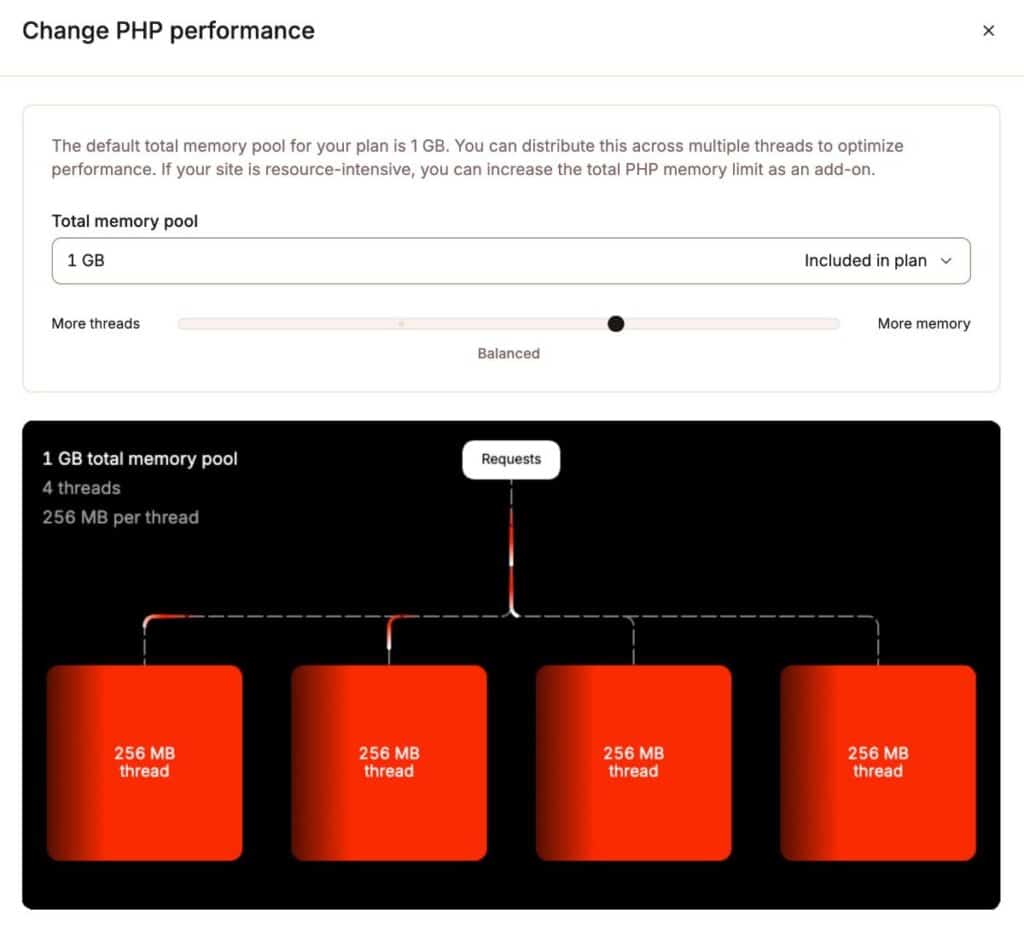
By avoiding auto-scaling, Kinsta protects you from “runaway” costs caused by unexpected traffic spikes or bot attacks, while still giving you the ability to scale up manually in seconds when you know you need it.
Kinsta’s approach also means you can experiment with optimizing system processes before scaling resources, giving you another way to control your costs more effectively.
Security protections
Container-based hosting also offers security benefits that help keep your site(s) safe, especially compared to traditional shared hosting.
As we mentioned earlier, containers isolate websites at the site level. This means that any security issues in one site are isolated to that container and won’t affect other sites, even within the same hosting account.
While VPS hosting provides isolation from other hosting accounts, it doesn’t provide isolation between sites hosted within the same account. This could be an important consideration if you’re planning to host multiple websites inside the same hosting account — either your own sites, or your clients’ sites.
Containers also offer a reduced attack surface, as a well-configured container typically runs fewer services than a virtual machine or a shared hosting environment.
Kinsta builds on top of the baseline security benefits of containers with other security protections, such as firewalls, malware scanning, and automatic backups.
Here are more details on the security benefits of container-based hosting.
Better fault tolerance
Containers also offer better fault tolerance than other hosting methods, which is especially important if you’re hosting multiple websites within the same hosting account.
With a VPS, the entire site stack runs within a single virtual machine. That includes the web server, PHP, database, OS, etc. If something goes wrong anywhere in that stack, the problem can affect all of the sites on that VPS.
Fixing the problem may require restarting services or, in some cases, rebooting the entire virtual machine; a process that can take minutes.
With container-based hosting, any problems are isolated to a single container. Then, because containers are lightweight and launch in seconds, it’s easy to instantly restart a container or specific services within it.
This also allows Kinsta to offer unique services such as self-healing PHP. If PHP goes down for any reason, Kinsta can automatically restart it for you to get things working again immediately.
To sum up: in addition to preventing some issues in the first place, containers can recover more quickly from those that do occur. Both of these lead to a more fault-tolerant system than other hosting methods.
How containers benefit different types of hosting users
Whether you’re hosting your own website, hosting clients’ websites, or working as a developer, Kinsta’s container-based approach can benefit you.
Here’s a quick summary of specific ways Kinsta’s container-based hosting approach can benefit different types of users…
Agencies hosting client websites
If you’re hosting clients’ websites, the isolation of containers is one of the most unique benefits:
- Isolation for each client site: While using a VPS or dedicated hosting to host all of your client sites might isolate your clients’ sites from other hosting accounts, it wouldn’t isolate them from other client websites hosted in your account.
- Stable performance across multiple client sites: Because containers isolate sites even within the same hosting account, you can offer stable performance for each individual client website.
- Easier site management: Because each site is in its own container, it’s easier to manage them and you can treat each site as a separate entity.
Containers keep your clients’ sites completely separate, while you manage everything from a single hosting account. While VPS hosting can keep your client sites isolated from other hosting accounts, it won’t isolate clients’ sites from each other (unless you’re using a separate VPS for each site, which adds a lot of overhead).
You’ll also enjoy other benefits such as improved security and performance, which your clients will appreciate.
Here are more details about Kinsta’s agency hosting for WordPress sites.
Individual website owners
For individual website owners, the performance and security benefits of containers can have the most direct impact:
- Faster load times for conversion rates: When combined with other performance optimizations, container-based hosting will help you get the best performance possible from your hosting resources. This can positively affect important metrics such as conversion rates and bounce rates.
- Reduced downtime risk: Because containers are so fault-tolerant, your site has a lower chance of downtime. In situations where something goes wrong, containers also enable faster recovery.
- Flexible scaling: You don’t need to worry about outgrowing your hosting as your website grows. Instead, you can easily add and remove resources as needed.
The isolation offered by containers is also still important for protecting your site from other hosting accounts (which can be an issue with shared hosting).
Developers
Finally, developers will appreciate the consistency of containers, which also makes for easier deployments:
- Consistent environments: Containers make it easier to maintain consistency across environments without managing full OS-level configuration.
- Easier debugging and deployment: Because of this consistency, it’s generally easier to debug and deploy containers.
Developers can also use the free DevKinsta software to easily set up local development container environments powered by Docker.
Recapping the benefits of container-based hosting
By isolating each site into its own environment, container-based hosting helps deliver:
- Per-site isolation, even within the same hosting account
- More consistent performance
- Stronger security boundaries
- Better fault tolerance
- Flexible, controlled scaling
Kinsta builds on these advantages by combining container-based infrastructure with performance optimizations, security protections, flexible dashboards and tools, and 24/7 support.
If you’re looking for hosting that prioritizes stability, performance, and control, head to Kinsta’s homepage to learn more and get started.

Kinsta
Steve Bonisteel is a Technical Editor at Kinsta who began his writing career as a print journalist, chasing ambulances and fire trucks. He has been covering Internet-related technology since the late 1990s.


