


Most WordPress outages don’t start with traffic spikes or infrastructure failures. They start with ordinary changes, such as a plugin update, a configuration file adjustment, or a small fix pushed live.
WordPress is powerful and flexible, but it also depends on people to keep it running smoothly, and that means mistakes are always part of the equation.
Reliability, then, doesn’t mean nothing can go wrong. It means understanding that something eventually will.
The real question isn’t how to eliminate these failures entirely. It’s how prepared you are when they happen. How quickly can you identify what broke, how safely can you reverse it, and how much impact does it have while you do? That is what ultimately defines reliability in practice.
Why human error is the real source of most downtime
It’s easy to assume that downtime is caused by traffic surges or infrastructure problems. In practice, most issues come from changes made to the site itself.
WordPress evolves constantly. Plugins are updated, themes are adjusted, configurations are refined, and content is edited. Each of these changes is made with a clear intention to improve something, but each also introduces a new variable into the system.
This is where small mistakes can have outsized effects. A minor syntax error in a configuration file, plugin update, or change in one part of the system can bring a site down.
That’s why these incidents are neither unusual nor avoidable in the long run. They are a natural outcome of working with a flexible, layered system.
The goal isn’t to eliminate human error entirely, but to recognize that it is inherent in how modern WordPress sites operate. Once that’s clear, the focus can shift from trying to prevent every issue to managing how those issues unfold.
Where things typically break
When something goes wrong, it usually isn’t random. Most failures fall into a few familiar categories:
Each of these shows up in slightly different ways, but they often start with small, routine changes.
At the configuration level, even minor mistakes can take a site offline immediately. A small syntax error in an .htaccess file, for example, is enough to trigger a server-level failure.
RewriteEngine On
RewriteRule ^index.php$ - [L
That missing closing bracket is easy to overlook, but it can result in a full site outage, typically showing up as:
500 Internal Server Error
The server encountered an internal error or misconfiguration.
Other configuration issues behave similarly. Incorrect database credentials in wp-config.php can prevent WordPress from connecting at all, while a typo in functions.php can lead to a white screen that locks both visitors and administrators out.
Conflicts between plugins and themes are another common source of breakage. Because everything runs in the same execution space, updates in one component can affect others in unexpected ways. A routine plugin update might break a checkout flow, disable a feature, or introduce errors that weren’t present before.
Issues also surface in the editor, especially on sites that rely heavily on blocks and JavaScript. A script error can cause the editor to load without controls or prevent content from saving. In some cases, the frontend continues to work while the backend becomes unusable for content teams.
More recently, configuration through files like theme.json has introduced another layer of risk. A misplaced setting or invalid structure might not take the entire site down, but it can lead to subtle issues that are harder to trace.
For example, a small structural mistake like this:
{
  "settings": {
    "color": {
      "palette": [
        {
          "name": "Primary",
          "slug": "primary",
          "color": "#0073aa"
        }
      ]
    }
  },
  "styles": {
    "color": {
      "text": "#333333"
    }
  }
}
This might look correct at a glance, but if keys are misplaced, duplicated, or don’t match the expected schema, WordPress may silently ignore parts of the configuration.
The result isn’t a visible error message. Instead, you might notice that expected styles don’t apply, editor controls disappear, or blocks behave inconsistently across pages.
Together, these reflect how WordPress behaves in day-to-day use, where small changes can ripple outward in ways that aren’t always obvious at first.
Why prevention alone doesn’t solve the problem
It’s natural to respond to these risks by tightening processes. Teams become more careful with updates, changes are reviewed more closely, and wherever possible, testing is introduced before anything reaches production.
These practices reduce the likelihood of issues and are essential to managing any WordPress site. But they don’t eliminate the problem.
Plugins evolve independently, dependencies change over time, and interactions between components are not always predictable. A change that looks safe during testing can behave differently in production, especially when it meets real data, real traffic, or a combination of plugins that weren’t accounted for. In many cases, issues aren’t caused by a single mistake, but by how multiple parts of the system interact under real conditions.
This is why being careful isn’t a guarantee of stability. It lowers the chances of something breaking, but it doesn’t remove the possibility entirely.
Backups are often treated as the fallback, and they are critical. However, having backups in place is only part of the equation. What matters just as much is how quickly and safely those backups can be used when something goes wrong. In some environments, restoring a site is immediate and controlled. In others, it involves delays, manual steps, or waiting on support, which extends the impact of the issue.
And while these incidents may not happen every day, their impact is rarely minor. A broken checkout, an inaccessible admin area, or a site-wide error can disrupt operations within minutes.
What reliability actually means in practice
At this point, it becomes clear that reliability is not just about avoiding mistakes but also about how the system responds when those mistakes inevitably occur. A site that never breaks is unrealistic. A site that recovers quickly and predictably is far more valuable in practice.
This shifts the focus from prevention to control. Instead of asking whether a change might introduce risk, the more useful question is how contained that risk is.
If something goes wrong, can it be isolated without affecting the entire site? Can the issue be identified immediately, or does it take time before anyone notices? And once it is identified, can it be reversed without adding complexity to an already stressful situation?
In practical terms, reliable systems are designed to make failure manageable. Changes are tested in environments that mirror production, not directly on live sites. When something breaks, there is a clear and fast way to return to a known working state. Monitoring for issues early, often before users report them. The goal is not to eliminate failure, but to ensure that failure does not escalate into prolonged downtime or broader disruption.
This is where the difference between setups becomes more visible. Two sites might experience the same issue, such as a problematic plugin update or a configuration error, but the outcome can be completely different. One recovers in minutes with minimal impact. The other remains unstable while the team works through manual fixes, restores, or support processes. The initial mistake is the same, but the system around it determines how disruptive it becomes.
How your hosting environment becomes the safety system
Once you start thinking about reliability in terms of both prevention and recovery, the role of your hosting environment changes.
It becomes the system that determines how safely you can make changes and how quickly you can recover when something goes wrong.
On the prevention side, the goal is to avoid introducing unnecessary risk into a live site. That usually means having a way to test changes before they reach production. Whether it’s a plugin update, a configuration tweak, or a new feature, being able to validate those changes in a staging environment reduces the chances of something breaking in front of users.
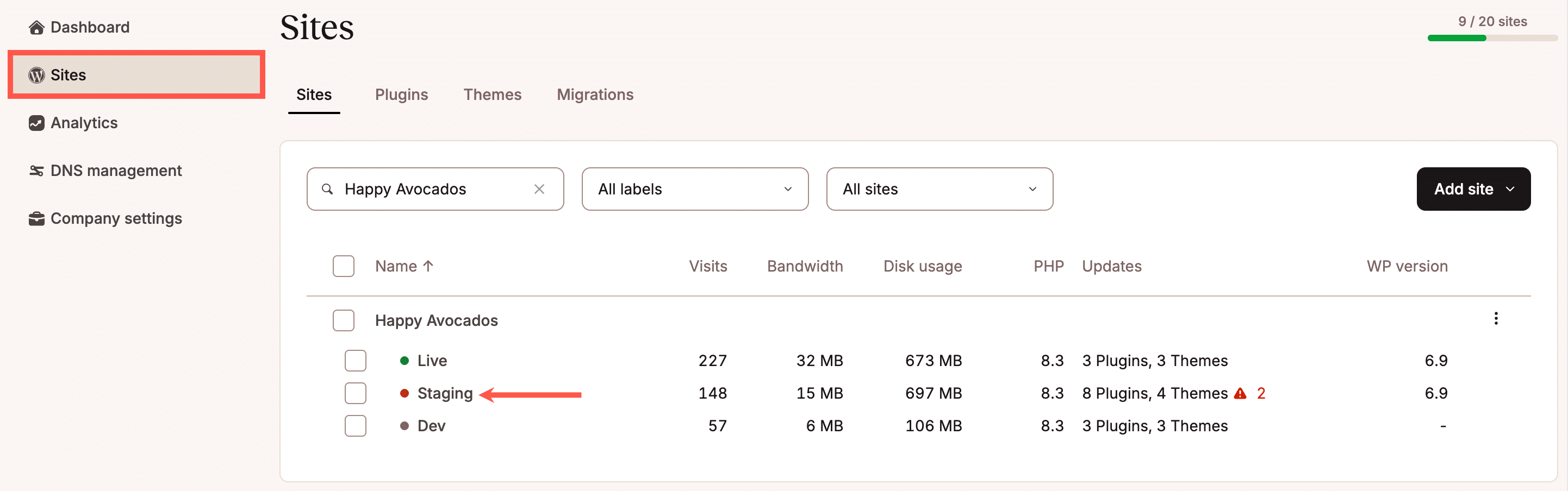
It doesn’t eliminate risk entirely, but it shifts it into a controlled space where issues can be caught early.
When something does break, the focus shifts immediately to recovery. This is where the difference between environments becomes more obvious. In some setups, restoring a site is a slow, manual process that involves multiple steps and uncertainty around what state the site will return to. In others, it’s a straightforward action that can be completed in minutes, with clear restore points and minimal disruption. That gap in recovery speed is often what determines whether an issue feels like a minor setback or a major incident.
Detection also plays a role here. If a problem isn’t visible right away, it can continue affecting users long before anyone on the team notices. Environments that provide clear monitoring and surface issues early help shorten that window, allowing teams to respond before the impact spreads.
Taken together, these capabilities change how teams work. Updates are no longer something to delay out of caution, and mistakes don’t carry the same level of risk because there is a clear path to recovery. The system supports both careful change and fast correction, which is what makes ongoing development sustainable.
Reliability is what happens after things go wrong
No matter how experienced the team is or how carefully changes are made, something will eventually break. That’s not a failure of process or discipline. It’s a natural outcome of working with a system that is constantly evolving.
What separates stable sites from fragile ones is how those mistakes are handled. When issues can be identified quickly, reversed safely, and contained without affecting the entire site, they stop being major incidents and become part of normal operations.
This is the kind of environment Kinsta is designed to support. From built-in staging and automatic backups to fast, controlled restore points, the goal is not just to keep sites online but to make them resilient to the everyday changes that typically cause problems.
If your current setup makes recovery slow, uncertain, or stressful, it may be worth rethinking not just how you manage your site, but the system that supports it.

Bud Kraus has been working with WordPress as an in-class and online instructor, site developer, and content creator since 2009. He has produced instructional videos and written many articles for WordPress businesses.


